
Research
Prof. Bates’s research focuses on the development agriculture and land use in South Asia. Her interests center around the relationships between people, plants and the environment, and how decisions made by people affect their worlds at different scales, from the micro-local to the climatic. As an archaeobotanical specialist, her main research contributions range from discussions on deep time landscape change through to domestication trajectories to reconstructing the urban-rural interactions in ‘complex’ civilizations. Prof Bates’s current projects are theoretically centered on using niche construction theory, human ecology, and Slow Archaeology to provide more grounded and wholistic images of the past.
Having begun in British and European prehistory, Prof. Bates moved over to South Asian archaeology during her university degrees. Starting in the Indus Civilization (see also continued work there) where she looked at the agency of farmers during urbanization, deurbanization and climate events, she has since moved across to the Middle Ganges Plains to think about rice domestication and the development of agricultural systems through to the historic periods. Her main project is currently the Indica Project, a multi-university collaboration that has MOUs with Banaras Hindu University, India (co-PI Prof. Vikas Kumar Singh). This project’s goal is to explore the complex nature of rice use in the Neolithic through later time periods, specifically tracking how rice, as a water-loving plant, was domesticated but also woven into other systems of food production and procurement, landscape modification, and foodways.
Linked to Indica are two additional but separate projects – the National Geographic funded Paddy project and the National Research Foundation (NRF) funded RiceMetrics. Both aim to address a key challenge in Asian archaeobotany – a lack of baseline models against which to compare our data. Most of the models utilised in archaeobotany are based on ethnographic or experimental work from the Near East and Europe – for example the crop processing work of Hillman and Jones on wheat and barley have been extended outwards and assumed to be similar globally despite ethnographic observations to the contrary linked to equipment, seasonality, weed ecologies and even the cereals themselves. When it comes to rice this is highly problematic as it does not grow in the dryland conditions of Near Eastern crops nor does it ‘behave’ like them in its appearance.
Paddy aims to redress some of the agricultural assumptions being made about the ways rice can be grown. Far from simply ‘having’ to be grown as a wetland rice (paddy’ed), rice can be grown in a myriad of ways, and a baseline model of how we identify when paddy, and when other growing systems such as transplantation, were used is vital as this affects other archaeological discussions (see debates on labour and urbanisation as an example). Using experimentally grown rice, in concert with expert heritage rice farmer Mr Lee at Woobo Farms, Paddy is assessing how we can methodologically best distinguish different rice growing conditions, and what variables have the biggest affect (eg: water versus sowing).
RiceMetrics similarly asks what variables affect rice, but focuses instead on identifying the types of rice being grown. While crops like wheat and barley are very much affected by domestication and subsequent species/subspecies selection, as a single domesticated species (Oryza sativa) rice grains are potentially more affected by watering conditions, other agricultural inputs (eg: manuring) and landrace choices (eg: selection fo hardiness, adaptation for local soil conditions, flavour). This project aims to explore whether traditional ratio morphometrics and GMM (geometric morphometrics) can distinguish between firstly the ‘type’ (indica/japonica/aus/aromatic/glutinous) and then other variables (watering, landrace, region etc.), or whether taphonomic factors like charring and cooking have a bigger effect on the grain. This project looks at three big climatic regions in Asia for comparison – tropical Thailand, sub-tropical India and temperate Korea – as a starting point for such work before expanding outwards in the future.
Other projects include exploring land use change globally through the larger LandCover6k team. This global multi-partner initiative aims to develop better data intigration of land cover and land use from deep time for ALCC (Anthropogenic Land Cover Change) modellers to use in climate hindcasting and forecasting. This is particularly important as we move into the Anthropocene, a topic Prof. Bates and the lab have been extensively researching and writing on. Prof. Bates has led the South Asia and Korean Working Groups in this effort.
Additional projects in recent years include work on Ashmounds, large artificial hills of burnt cattle dung in South India, as well as collaborations with the EHLTC and SILT projects from UPenn. Projects also currently underway include the analysis of historically collected materials from Indus sites in north India, analysis of irrigation systems around the Mesopotamian Royal City of Ur, and study of the Palaeolithic landscapes of the UK.
Prof. Bates also oversees multiple student projects in the lab and welcomes students and post-doc applicants with ideas/materials from any part of the world.

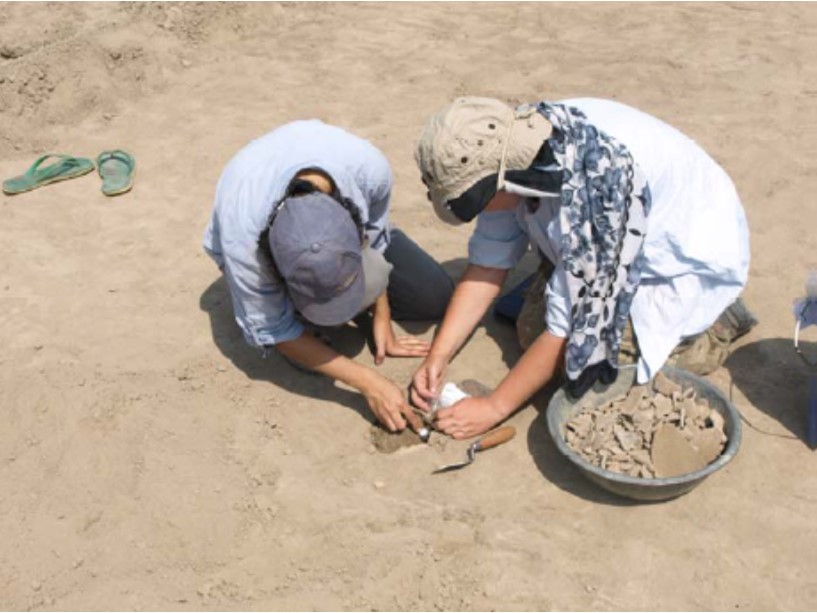

 SNU Archaeological Labs